









BMW is celebrating 100 years of motorcycle production this year, and the manufacturer invited BDN to Munich to see a couple of new bikes while taking in a new ‘100 Years’ exhibition at the firm’s corporate museum, based at the famous BMW ‘Four Cylinder’ HQ near the Olympic Park. The boss of BMW Motorrad, Dr Markus Schramm, was there, and he answered our questions on the current state of play for the brand.
First up was a tour of the new centenary exhibition. The BMW Museum has a central bowl structure, with a winding pathway up to the main level, and there are exhibits set up all the way along. Visitors get a taste of the firm’s early two-wheeled history, with the first Boxer engine – the 6bhp M2B15 from the R32 – on show alongside the very latest 136bhp R1250 Shiftcam motor. Milestone machines, like the R37, the R5, the R75/5, R90 S, R80 G/S, S1000 RR and more, are on show, and there are even super rare prototypes like the desmodromic-valved 996cc R1 superbike from 1992 and the art-deco styled 1937 R7.
Developments in carbon-neutral e-fuels may help bikes escape the proposed ban on petrol and diesel engines for cars in the EU from 2035
The 100 Years showcase also looks at the important figures in the firm’s history, from Max Friz, who designed the first Boxer, through to German designer Hans Muth who was behind the R90 S and R100 RS. BMW’s competition heroes also get a mention, with shrines to desert race aces Gaston Rahier and Hubert Auriol, plus road race legends including Georg Meier and Michael Dunlop. BMW also tips its hat to the pioneer adventure tourers who set out on BMW bikes back in the day, such as British architect Elspeth Beard who circled the globe in 1982 on an R60/6.
Open until next May; the 100 Years exhibition is well worth a look. Opening times are Tues-Sun 10am-6pm, and entry is €10.
Dr Markus Schramm
A veteran of BMW, Dr Markus Schramm has been at the firm since 1991, and took over as head of BMW Motorrad in 2018. The keen motorcyclist and marathon runner spoke to BDN at the special 100 Year exhibition opening and gave an update on where BMW is now and how it’s coped with the recent crises.
We started by asking how the firm managed to achieve record sales of almost 203,000 bikes last year, with Covid, semiconductor and logistic woes, and a war in Europe all having an effect.
“The secret behind us is the strength of the brand, which we’ve invested heavily in for the past five years,” said Schramm. “Yes, certainly Covid was a challenge for us. Can you imagine that we had to shut down our plant for six weeks, and the first day after we opened up again, we had to start production of the R18? At the same time, parallel to the Covid situation, we had significant challenges with semiconductors. We set up our own task force linked to the car side and managed much better than the car industry.”
And Schramm gave a concrete example of the practical impacts of the war in Ukraine. “75% of our wiring harnesses are produced in Ukraine. So, one day [when the war began in February 2022], there were no harnesses… In record time, we built up parallel production in India, Thailand and South Africa. But four weeks after we launched the first production in Thailand, the women in the Ukrainian plant (harness production staff are 100% women) were back on two shifts. Can you imagine, these women were sending their father or son or husband to war, and they came back to shift operation after four weeks?
“We went immediately back to Ukraine, and we said you are our partner, and now they are back to the same volume as before the war, and we are very proud that we could support them.”
Schramm spoke about BMW’s global successes next. “For us, the fastest growing market in 2022 was India, followed by China. So especially in Asia, we are very successful. We always joke that we have a ‘20,000 Club’, which means 20,000 bikes are sold in a country. We did this for some years in France and in Germany for a long time. But now China is joining the club. Italy wants to join and the US is joining the club.”
What about the UK? “The UK is far away – the UK needs to push to join the 10,000 club! But this is certainly a very good indication that our success is not built on one region. It’s really spread over the world.”
Schramm was also, perhaps surprisingly, quite bullish about the prospects for future internal combustion engines in motorcycles while also praising BMW’s efforts on electric power. He claimed that its CE 04 scooter had more than 80% of the global market for over-11kW battery-powered bikes in the first quarter of 2023 while accepting the bike world is some way behind in electric acceptance. “Compared to cars, we are at least ten years behind in terms of acceptance, in terms of getting customers by emotional means, not regulation. But it comes! Last year 2.5% of our retail sales were electric and the car side was there ten years ago. This year we’ve got 5%.”
But the good doctor also pointed out that bikes produce a tiny amount of CO2 in Europe – just 0.3%. And he suggested that this, alongside developments in carbon-neutral e-fuels, may help bikes escape the proposed ban on petrol and diesel engines for cars in the EU from 2035.
“At the end of the day, we have 0.3% of the CO2 emissions in Europe, so we don’t need too much lobbying, and also, we are under the radar. Two-wheelers were always excluded from the European Commission’s Green Deal and potential ICE ban. It was always mentioned as only cars.”
Could the UK government take this on board as part of its consultation on cutting carbon emissions? It would be a big help to the industry if it did.
New Models
BMW showed off two brand new models at its 100 Years event. First is a new retro bagger version of the massive R18 cruiser called the Roctane. It marries up the basic dynamic package of the R18 – 91bhp 1802cc Boxer, steel tube frame, shaft drive – with a new 21in custom front wheel, built-in swoopy panniers, footboards and an R5-style headlight surround. Priced at £22k, it looks very striking but will undoubtedly be a niche seller in the UK.
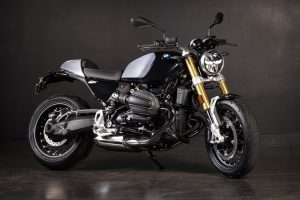 BMW R 12 nineT
More mainstream was the next reveal – the new R12 nineT. The confusing name was explained as a rebrand of BMW’s 1200cc heritage line-up to fit in below the R18 family – expect a range of R12 models next year based around this new platform. The air/oil-cooled engine is apparently all-new despite looking very similar to the current ‘oilhead’ R nineT unit, and it claims to have better performance and improved future emissions compliance while offering more support for the latest high-tech digital systems.
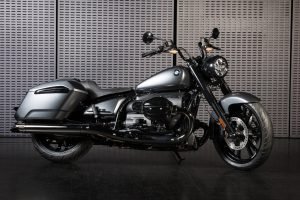 BMW R 18 Roctane
This next-generation R nineT replacement will also be even more customisable, with owners able to swap out parts like the dual-analogue clock pods for a trick TFT LCD screen, as well as the usual seat, wheels, exhaust and other more cosmetic customising options. The new bike will also be compatible with BMW’s smartphone apps, allowing retro fans to buy a bike that matches their style while also getting the modern tech common across the rest of the BMW range.
The new R12 nineT we saw was a pre-production prototype: the firm is launching it as a 2024 model and will release more info later this year.