










Alan Dowds looks for the missing link!
The Motor Cycle Industry Association (MCIA) held its annual Industry Conference in January. The event at the National Motorcycle Museum was a much bigger affair than before and was the second in its new format after the association moved away from the more intimate event held at the Motorcycle Live show. The 2024 conference welcomed more than 200 attendees from across the industry, who saw presentations from politicians, economists and trade experts, as well as valuable insights into training, AI and online selling.
The event started with a welcome from the current chairman of the MCIA, Honda’s head of motorcycling, Neil Fletcher, before heading straight into the political arena – appropriate in this UK general election year. Heading the bill of speakers were two Conservative MPs – Anthony Browne, the MP for South Cambridgeshire and under-secretary of state for transport, and Ian Stewart, the MP for Milton Keynes South and transport select committee chair. Sadly, though, neither had seen fit to actually turn up in person, sending a brace of minimal-effort video presentations instead, which played 1984-style on the big screen. The reaction in the auditorium felt somewhat disdainful at the lack of personal attendance from anyone in government. The presentations offered nothing in terms of concrete proposals for anything in terms of motorcycle industry aid, improvements to licencing rules, or even any hints about decarbonisation for powered two wheelers.
We’ll see a 1.6% increase to 115,400 bikes registered overall this year
By contrast, and perhaps unsurprisingly considering the current state of the opinion polls, there were two Labour MPs, both of whom turned up in person and gave speeches. Fabian Hamilton, transport select committee member and MP for Leeds North East, was the highlight, with stories of his Honda CB1000R, his conversion to motorcycling later on in life, and clear enthusiasm for powered two-wheelers. Hamilton certainly seems like a politician who would be willing to get in and fight for the bike industry.
The second Labour MP was Sarah Jones, the member for Croydon Central and shadow minister for industry and decarbonisation. Jones gave a speech heavy on positivity but almost as devoid of motorcycle-specific pledges as the Tory talking heads on the screen earlier. Indeed, her speech on what a possible future Labour government might offer the bike trade could have applied to any number of other sectors – you could have swapped motorcycling for “car manufacture”, “shipbuilding”, “retail” or “steel production” and the speech would have worked just as well in those industries’ conferences. The promises of a long-term plan, stable politics, fiscal responsibility, industrial strategy, energy prices, giga-factories and consumer confidence would be familiar to anyone listening to any speech made by any Labour shadow minister over the past couple of years. Jones hit out at the current government for its tardy approach to the petrol phase-out date for bikes – but gave no sign of what her party would do instead. Watch this space to see if things improve after the election (but don’t hold your breath).
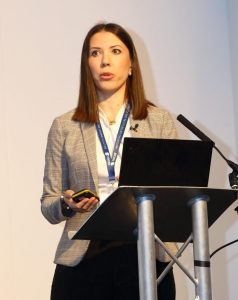 Dr Anna Jerzewska, international
trade specialist
After the politics came a pair of presentations that looked to be drier than the Yemeni desert from economist, Jeremy Leonard of Oxford Economics, and an international trade specialist, Dr Anna Jerzewska, of Trade and Borders. Leonard’s presentation was surprisingly upbeat, with a positive analysis of the potential upsides for the UK and global economy in 2024. He even brushed aside concerns about the Houthi-launched missiles raining down on container ships from those Yemeni sands, suggesting that the situation in the Red Sea is unlikely to increase inflationary costs by more than a few per cent across the economy – although supply chains might see some disruptions in terms of delivery times.
Leonard pointed out that the headwinds of higher interest rates are still impacting the economy. On the upside, forecasts seem to suggest that inflation will continue to come down, bringing lower interest rates, and oil prices are also set to decline thanks to strong supply and weaker demand. A more pessimistic view was taken of wage growth, with what increases there are in discretionary spending being eroded by the “bracket creep” of the income tax threshold freeze put in place by the current government post-Covid.
Canadian economist Leonard finished with a dispassionate statement about the impact of Brexit: since 2022, UK growth has lagged that of other G7 nations, and the expected GDP gap between the UK and the rest of G7 will reach about 4% by the end of 2026, thanks to the trade barriers brought about by leaving the EU.
 David Higham, head of growth and innovation, Nottingham College EMTEC automotive training centre
Dr Jerzewska also looked at the impacts of Brexit, with a fairly deep dive into customs duties, the latest UK trade agreements with Australia, New Zealand, Singapore and Japan, as well as roll-over legacy agreements brought over from EU deals. Dr Jerzewska stressed the importance of “rules of origin” classifications and the need for importers and exporters to have specialist knowledge on board to get the best possible tariff rates. She also warned about mistakes: if tariff claims are incorrect, duties will be due for up to three years back, and firms can suffer massive losses.
After a networking lunch, the conference kicked off again with a look at the 2023 registration figures led by MCIA CEO Tony Campbell. BDN has looked at these figures, so we already know about the 2.5% drop in overall registrations and the poor performance of battery electric products, which were down 37.8%. What was new was the MCIA prediction for 2024 – the association reckons we’ll see a 1.6% increase to 115,400 bikes registered overall this year, thanks to a stronger economy and a continued return to pre-Covid performance. We’ll see how good that prediction is in 12 months’ time!
The final part of the day was handed over to a mixture of solid real-world industry issues, like online bike retailing, apprenticeships and training, and the more esoteric subject of artificial intelligence. Matthew Atherton, sales director at Auto Trader, looked at how the landscape has changed – and continues to evolve – for online bike sellers and outlined one new model: “Digital journeys with physical retailing” was the catchphrase, with the suggestion that almost everyone carries out buying research online – but they also all end up visiting a dealership in person when actually purchasing. Interestingly, he showed research that suggests the majority of buyers also still use dealership financing deals.
David Higham, head of growth and innovation at Nottingham College’s EMTEC automotive training centre, spoke about apprenticeship provision and how it can help the trade bring in new trained staff. He stressed that apprenticeships aren’t just for young people – and outlined the various claimed benefits, including lower staff turnover, higher staff morale, improved productivity and matching staff skills to those you need as a business.
The discussion on artificial intelligence felt like a bit of fun, with speaker Justin Cooke of BridgeLT covering basics of ChatGPT and generative AI, such as the Midjourney image creator, plus case studies from Harley-Davidson and Yamaha. He outlined some of the opportunities and challenges and pointed out that many of the future jobs in the AI business don’t yet exist – indeed, nearly 70% of ‘jobs on the rise’ on LinkedIn didn’t exist 20 years ago. He finished with a pithy quote from Professor Richard Baldwin at the Geneva Graduate Institute: “AI won’t take your job. Somebody using AI will.” Thought-provoking stuff.
After the event, and summing up, MCIA CEO Tony Campbell said: “More than 200 guests joined us at the second running of the MCIA Industry Conference; the event was very well received as it covered the key topics affecting our sector both now and in the future. We plan to run this event annually and will constantly review the format to ensure it remains relevant and informative to all our members, politicians and invited guests.”