










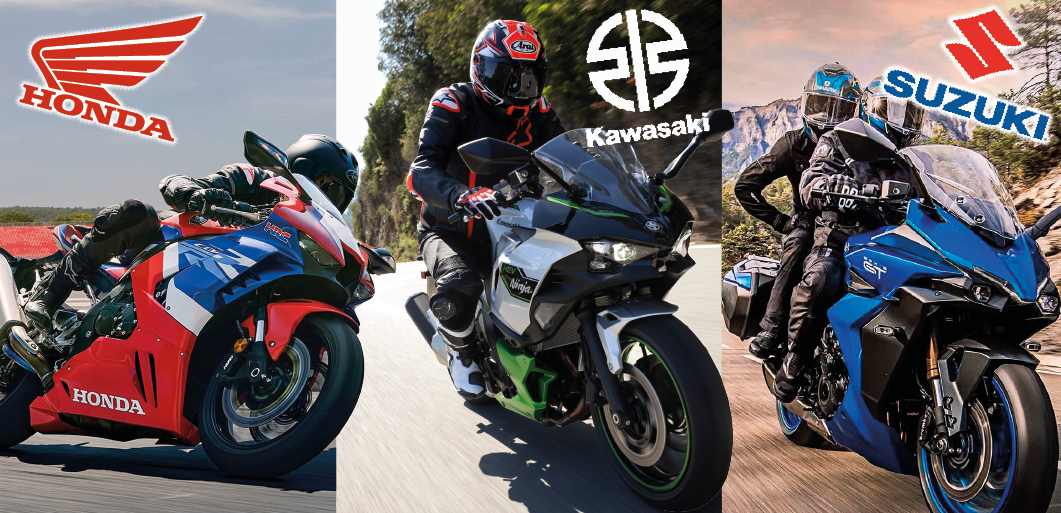
Nine months of the way through their current fiscal years, which will end on 31 March 2024, the fortunes of the Honda, Kawasaki and Suzuki motorcycle operations display wide differences. But a common denominator is static or weakening unit sales, mainly driven by adverse geo-political and economic factors in Asia.
HONDA: ON TARGET
Honda’s enormous motorcycle business is ahead on monetary targets but still playing “catch-up” on sales volume forecasts. Revenue was 7.1% up to £12.547bn. Operating profit increased by 9.3% to £2.189bn, with an operating margin gain to 17.5% from 17.1%. But worldwide wholesale shipments were 2.3% down to 13.961 million units.
Developed markets were healthy, though. Unit sales in Europe staged a strong recovery, 45.3% up to 324,000. North America grew by 10.3% to 374,000. Japanese domestic sales added a modest 1.1% to 181,000.
However, Asian performance fell by 3.5% to 11.884 million and other emerging regions were 2.9% down to 1.198 million, despite a 9% rise in output to 908,000 bikes from Honda’s Manaus production hub in Brazil. Primary culprit was an economic slowdown in Vietnam, where sales slumped by 18.7% to 1.576 million. Best show came from the Astra Honda joint venture in Indonesia, responsible for 13.2% growth to 3.445 million. Honda’s wholly-owned HMSI Indian subsidiary put on 1.6% to 3.376 million and its hub in Thailand contributed a 1.4% rise to 1.079 million.
Full-year unit sales forecasts tell a slightly different story. Overall global sales are expected to increase marginally by 0.2% to 18.8 million. Some 15.965 million of these will come from Asia, an upwards revision of 20,000. North American sales have also been revised positively to 505,000. European headcount revision is in the opposite direction, down from a 465,000 estimate to 460,000. Japan gets similar treatment, dropping from 255,000 to 245,000, as do other regions, losing 10,000 units to 1.625 million.
A somewhat disturbing electrification update tacked on to the results statement claims Honda will have more than ten battery-electric models by 2025 and approximately 30 by 2030. The company’s commitment to a hydrogen-fuelled future appears to have vanished.
KAWASAKI: ANOTHER FINE MESS
The powersports and engine division of Kawasaki Heavy Industries looks like a copybook example of corporate incompetence, after a strong two-year financial recovery from the Covid pandemic.
A 2.2% turnover decline to £2.146bn doesn’t sound that serious, until it’s set alongside three-quarterly operating profit, which plunged by 40.4% to £169.8m. Kawasaki blamed this sorry state of affairs on a £108.8m loss owing to “change in product mix and other factors” and then a further £64.2m reversal attributed to “change in selling, general and administrative expenses”. Operating margin, incidentally, dived from 13% to 7.9%. The sordid details are not enthralling.
Revenue generated by motorcycle shipments to developed markets worldwide was 2.6% down to £721.2m. But wholesale volume supplied to those destinations was 16.6% lower at 131,000 units. Europe topped the pile, 10.5% up to 42,000, although European performance was tempered by apparently still-recovering supply capacity. Domestic sales to dealers in Japan was the only other source of growth, thanks to a 15% rise to 23,000. US sales dropped by 34.6% to 53,000. Canada was 37.5% in arrears at 5000. Australia fell by 25% to 6000.
Revenue from motorcycles destined for emerging countries was considerably worse, sinking by 14.2% to £391.1m. And total wholesale volume plummeted by 32.4% to 161,000 units. The Philippines suffered most volumetrically, 34.8% down to 103,000. Indonesia fell by 36.4% to 21,000. China retreated by 20% to 16,000. Numbers in Brazil, Thailand and elsewhere were so low as to be not worth counting.
In both contexts, supply-chain risks figured, with a “continued impact on production due to shortage of parts” – the only Japanese manufacturer now hiding behind this tired Covid-era excuse. In addition, turnover from general-purpose petrol engines had tanked too, falling by 14.3% to £342.8m.
What should have been a saving grace aimed primarily at the US market followed – but wasn’t. Revenue from four-wheeled utility and recreational ORVs, ATVs and personal watercraft had indeed grown by 15.2% to £689.4m. However, a relevant qualification to the results statement surfaced, spoiling this party.
This referred to: “A received notice from the US Consumer Product Safety Commission, to impose fines in connection with a recall of certain models of off-road four-wheeler.” We also learnt that “recall-related expenses” had already impinged upon Q3 profitability and the Q4 profit forecast would be revised down. Older readers may remember an expensive early-90s Kawasaki iced-up motorcycle carburettors recall, involving mountains of replacement parts. Maybe this one features refrigerated EFI on four wheels? No actual details were made available.
So full-year forecast amendments were a thorough mess. Although the reduction in annualised turnover was negligible, a mere 0.2% to £3.131bn, profits became harder to find. An original deeply pessimistic estimate made at the end of Q1, predicting a 30.1% operating profit decline to £265.3m, with operating margin down from 12.1% to 8.5%, had been adjusted in November when the ORV recall issues became egregious. The current forecast now has operating profit 34.3% lower to £249.4m, with operating margin sinking to 8%. A final countdown at the end of March may be more severe.
SUZUKI: WINNERS AND LOSERS
Suzuki’s refreshed motorcycle range for European markets seems to be paying off handsomely. However, performance elsewhere was mixed. Global revenue for the Suzuki motorcycle business grew by 5.9% to £1.433bn. Sector operating profit was 16.6% up to £143m. Turnover highlights were a 16.7% increase to £175.9m in Europe and a 30.8% improvement to £463.6m in India. Asian revenue as a whole, including India, only rose by 7.9% to £720.5m. North American turnover declined by 6.1% to £190.9m.
Worldwide bike sales volume for the brand was just 1.7% higher at 1.445 million units. In the developed world, Europe led the field, 27.9% up to 28,000. North America fell by 9.7% to 23,000. Japanese domestic sales were 10.3% down to 30,000. India was the emerging markets star, with sales climbing by 19.7% to 657,000. Excluding Indian success, the rest of Asia slumped by 11.7% to 550,000. Within that, China fell by 6.1% to 316,000 and the Phillipines dropped by 17.3% to 125,000. Elsewhere, Latin America was 6.2% down on 140,000.
During the three quarters, total motorcycle production volume virtually flatlined, only 0.9% up to 1.432 million units. Indian manufacturing increased by 27.9% to 719,000. The rest of Asia accounted for a 17.5% reduction to 571,000. Domestic Japanese production sank by 4.8% to 79,000. A further 2000 machines were assembled in North America.
Latest full-year forecasts predict a 2.5% production decline to 1.867 million units, versus 1.7% sales volume growth to 1.899 million. Asian markets should be responsible for 1.584 million of those, 3.1% up. North America and Japan will incur modest losses, while Europe should be 25.8% up to 39,000.