








1941-2024
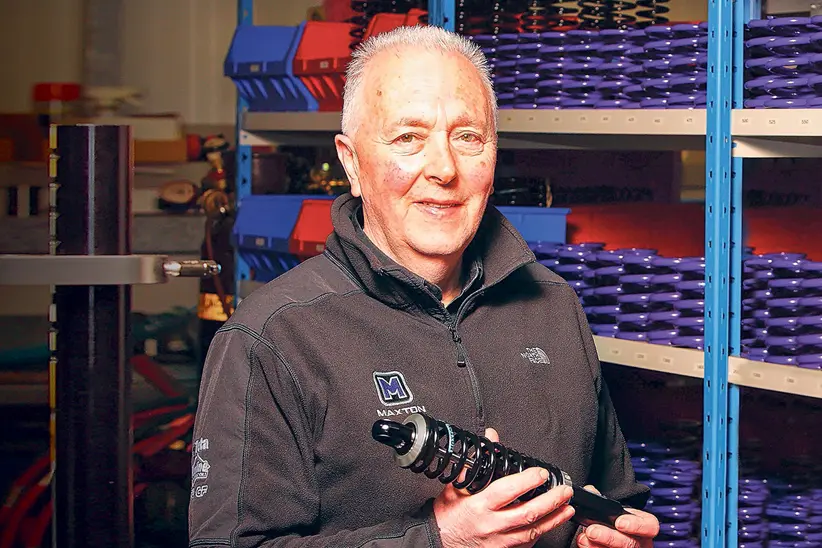
Ron Williams, founder of road race-based Maxton Engineering and Maxton Suspension, has died aged 83.
Best known in recent decades for his suspension expertise, Williams was a talented engineer who loved problem-solving and had an unshakable research and development mindset in wanting to continually improve his products. The next project was always his focus. What had gone before was consigned to history.
His enterprises included making road race frames, magnesium alloy wheels, and state-of-the-art suspension components. He was courted by leading manufacturers, including Honda and Yamaha, as well as by leading race teams.
Williams, a quiet, modest type, happiest in his workshop, first came to the notice of the motorcycle scene by taking a world standing-start quarter-mile 500cc speed record (10.78s) at Elvington, Yorkshire, in 1969 using a supercharged 500cc Triumph engine in his own frame.
Born in Eccles, Lancashire, he left school at 15 to take an apprenticeship at Metropolitan Vickers (now AEI), Trafford Park, Manchester, studying to become a draughtsman.
Aged 25 in 1966, he joined Chevron Cars, Bolton, Lancashire, as a design draughtsman. By this time, he had a consuming interest in motorcycles as well as race car technology.
When his mother died in 1970, he gave up full-time work to look after his father at the family home in Worsley, Manchester. It was in the garage where Maxton Engineering was born.
His first customer frame was for a 500 Matchless G50 road racer. Then, he followed his first Maxton frame with frames for the Yamaha twins. In the 1970s Yamaha dominated 250 and 350cc class racing with its TD and TZ models, and Williams could see business and creative potential in this area because the standard Yamaha frames were fragile.
Yamaha dealer Dugdale Motors of Alvanley, Cheshire, sponsors of Isle of Man TT winner Charlie Williams, recognised his talent and offered him a workshop at its premises in 1978. Not happy with the workshop, Williams moved into a nearby chapel the same year.
It is estimated that Williams made up to 50 race frames, TT winner Chas Mortimer regarded as the leading exponent of Maxton Yamahas. Of those frames only one was for a road Yamaha, which Williams reluctantly agreed to make. Williams also made frames for Rotax race engines and F1 race bikes.
In 1980, he received a phone call from Gerald Davidson of Honda’s racing wing. This led to Williams becoming a Honda consultant until 1989. The association led to working on frame design for the NR500 grand prix bike and spending two months in Japan training Honda apprentices.
In the off-season work at Maxton Engineering continued. Williams could see an opening for 17in magnesium-alloy wheels, especially for Honda’s landmark 750 RC30 V4 (UK launch 1987). He made wheels from 1987 to 1989, when a Japanese company bought the wheel business.
In 1990, Norton’s race manager, Barry Symmons, asked Williams to design a frame for the Rotary Norton. Williams produced an ultra-lightweight design made by frame specialists Harris Performance. Using this frame, Steve Hislop won the 1992 Isle of Man Senior TT, a victory widely regarded as one of the highlights of post-war TT racing.
In 1993, Williams started to concentrate on suspension, initially sourcing components from Koni in Holland and reworking them for motorcycle road and track use, including making mono-shock units. This became highly successful as the superbike era boomed. GSX-R Suzuki owners were big customers. Williams had been one of the first to provide mono-shock conversions for racing Yamahas in the 1970s.
By 1999, more than 90% of Maxton suspension components were made in-house to ensure strict quality control. Suspension set-up was and is also part of the Maxton service.
John McGuinness and Dean Harrison were among the top teams and riders seeking Maxton suspension expertise. Joey Dunlop, a 26-time TT winner, also used Maxton’s suspension.
Williams’ stepson, Richard Adams, joined Maxton in 1995, taking over general management in 2004 when Williams was 63. Maxton Suspension continued to expand, moving into new purpose-built premises in 2009 and acquiring more CNC equipment. With the move, Williams eased pace but continued to attend daily and work on development until suffering a stroke in 2020.
Ron Williams was a quiet, modest person who loved the Isle of Man TT, jazz music, walks, and designing and working on frame and suspension development.
“Ron was a very clever guy for whom we had a lot of respect,” says Lester Harris of Harris Performance. “There wasn’t much he didn’t know about motorcycle design.”
“Ron was such a gentleman,” says Maxton Yamaha owner Chris Bladon. “Very quiet, modest, a brilliant engineer. We held him in such esteem.”
“You couldn’t wish for a better friend,” says Steve Carthy owner of eight Maxton framed machines.
“Ron taught me how to rebuild race crankshafts, and he made the special tooling for me,” says Steve’s wife, Michelle, who rebuilds race cranks professionally (Michelle Carthy Cranks).
“He loved to cure problems and was always looking forward…. and he was my dad for 44 years,” says stepson Richard Adams, who is overseeing further expansion of Maxton Suspension with new CNC machinery extension due to be in action this month with a total staff of 12. Business is split 50/50 road/race, and Maxton continues to work with leading race teams.
Ron Williams leaves wife Mary and stepsons Richard and Matthew.