









Full-year financial figures and forecasts from Honda, Kawasaki and Suzuki provide a mixture of sparkle and caution.
HONDA HEGEMONY ABSOLUTE
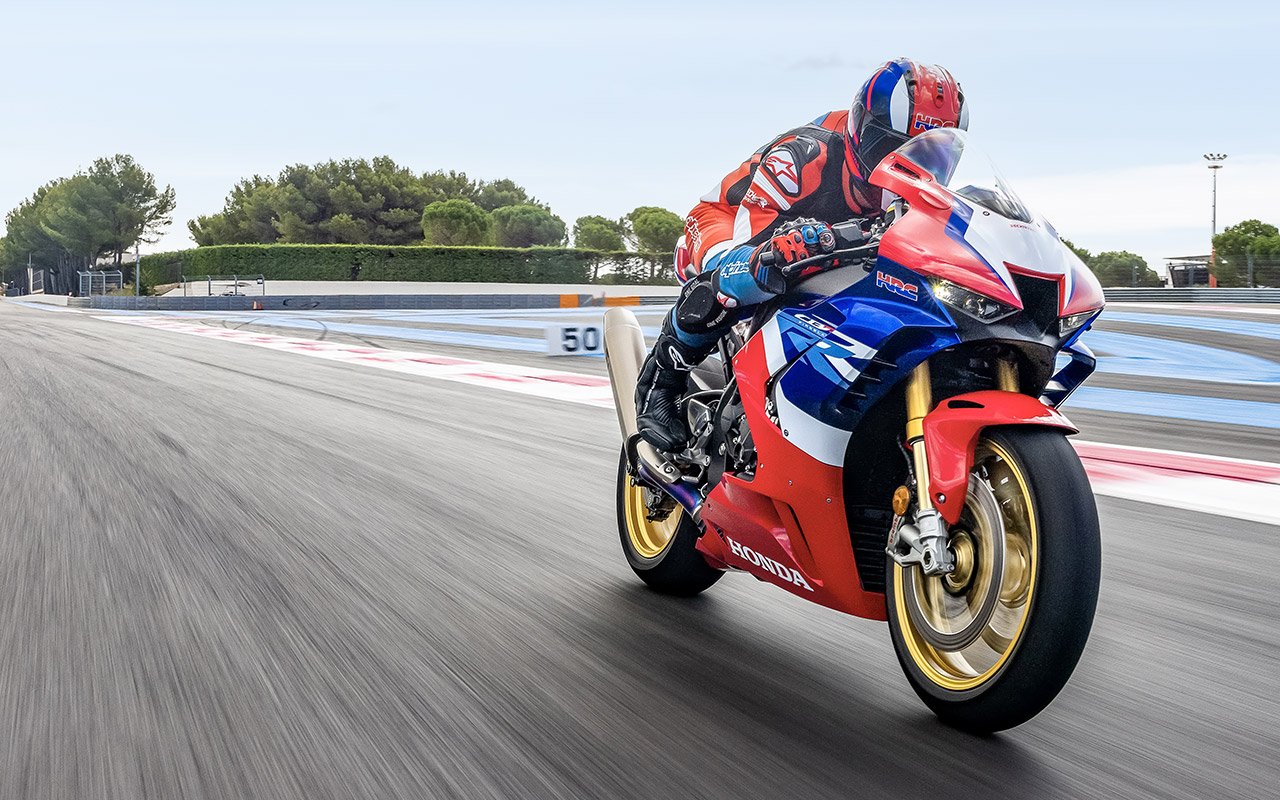
We knew that mind-boggling numbers were on their way, from year-end forecasts issued three months previously. But Honda’s massive motorcycle business didn’t even bother with bragging rights when they finally landed. During its full fiscal year to 31 March 2025, global Honda motorcycle output climbed by 9.3%, surging to an extraordinary 20.572 million units sold.
To report such stupendous volume, the company actually began on a negative note. Its Japanese domestic sales slumped by 7.1% to 224,000 units. But crucial Asian sales, including those from the really big-league players of its HMSI subsidiary in India and joint-venture affiliate Astra Honda in Indonesia, climbed by 9.1% to 17.478 million. Other emerging and smaller regions contributed a 13.7% rise to 1.847 million. In the developed world offering the opportunity of much higher pricing, North American sales stacked on 10% to 548,000 and European headcount increased by 7.9% to 475,000.
Total resultant revenue was 12.6% up to an astronomic £18.536bn. Operating profit grew by 19.3% to a similarly muscle-bound £3.391bn. Operating margin improved from 17.3% to 18.3%.
Naturally, Honda has no intention of standing still in its new fiscal year through to 31 March 2026, although the immediate forecast will obviously be amended quarter by quarter – especially against the current volatile geo-political background. At the moment, Honda is predicting global growth of 728,000 units to a fresh peak of 21.3 million. But that will be confined to Asian and other emerging markets. It says the developed world is likely to face difficulties and European sales in particular are flagged for shrinkage of 45,000 units to 430,000.
Yen-£ currency translation at forex rates on 13 May
SLIM GAIN FOR TEAM GREEN
Although Kawasaki Heavy Industries’ Powersport and Engine division achieved a positive turnover figure in its full fiscal year to 31 March 2025, thanks primarily to increasing motorcycle sales volume, the business undershot targets and profitability flatlined.
Total twelve-monthly revenue grew by 2.9% to £3.146bn, against a forecast of £3.304bn. Operating profit fell slightly, by 0.6% to £246.8m, and operating margin retreated from 8.1% to 7.9%. Turnover from motorcycles for developed countries increased by 12.6% to £1.267bn, with wholesale volume 10.9% up to 234,000 units. Biggest contributors were North America, 23.4% up to 116,000 units, and Europe’s 6.6% rise to 81,000 units.
Revenue from motorcycles for emerging markets, mainly in Asia but also including Latin America, fell by 4.1% to £512.3m. Wholesale volume rose by 5.6% to 246,000 units. The Philippines provided by far the best performance, 30.1% up to 186,000 units.
Turnover from utility vehicles, ATVs and personal watercraft, principally destined for North America, declined by 6.4% to £872.7m, due to a recall and subsequent production delay for the Mule Pro 1000 series. Revenue from general-purpose petrol engines grew by 5.8% to £493.2m.
Kawasaki’s market overview for the year said that while street motorcycle sales in the US had remained firm, the off-road bike market had softened. And although the US market for utility and recreational vehicles is expected to grow, sales of the latter models has weakened, because they are susceptible to loan interest rate increases. Concern was also expressed about the US administration’s tariff measures having a negative impact on demand for both motorcycles, utility and recreational vehicles. On a brighter note, Kawasaki’s European retail motorcycle market remains strong and it says market share is growing due to stronger sales promotion activities and the effect of new models.
The division’s new-year financial forecast estimates that annual revenue should improve to £3.408bn, but operating profit will remain virtually static for a variety of reasons.
Yen-£ currency translation at forex rates applicable on 19 May
SUZUKI BACK IN THE FAST LANE
With sales expansion in India as the current relentless driving force, Suzuki’s motorcycle business has just delivered solid annual results for the 12 months to 31 March 2025.
 Revenue rose by 9.1% to £2.037bn. Operating profit was a more modest 4.4% up to £208.8m. Turnover from Asian operations dominated, 16.6% up to £1.108bn. And inclusive Indian performance was to the fore, rising by 19.3% to £740.9m. Other emerging markets improved by 12.1% to £407.8m. Developed markets weren’t so promising. European turnover declined by 6.6% to £223.1m. North America was 15.7% down to £203.6m. Domestic revenue in Japan fell by 7.1% to £94.2m.
Motorcycle production during the fiscal year grew by 6.7% to 2.042 million units. Suzuki’s wholly-owned Indian subsidiary manufactured 1.13 million of them, while various other Asia countries were responsible for 706,000 and 91,000 were made in Japan. 114,000 were produced elsewhere.
Global Suzuki motorcycle sales volume increased by 7.9% to 2.064 million units. India was star of the show, sales up 18% year-on-year and exceeding a magic million for the first time – 1.048 million to be precise. There were another 647,000 sold into various Asian destinations and a further 264,000 went to other emerging targets. Developed wholesale markets looked thin by comparison – 30,000 in North America, 40,000 in Europe and 35,000 on Japanese home turf.
New year production and sales projection forecasts lacked detail, though. The former bills a slight decline to 2.028 million, with 1.824 million produced on an Asian/Indian axis, while sales improve marginally to 2.078 million, again focusing on Asia/India demand. Oddly, European numbers are expected to slip to 37,000 as America recovers to 33,000.
Yen-£ currency translation at forex rates applicable on 12 May
NEW CARBON-NEUTRAL SUZUKI AT SUZUKA
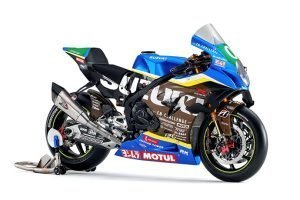
Most interesting is Suzuki’s welcome support for a CN (carbon-neutral) stance keeping motorcycles with internal combustion engines alive. After last year’s Suzuka Eight Hours Endurance Race featured an experimental GSX-R1000R running on E40 biofuel which acheived a top-ten finish, Suzuki Motor Corporation committed to a new 2025 CN Challenge GSX-R1000R competing in the Suzuka Eight Hours this August.
This bike will be fuelled by Total Energies Excellium Racing E100 certified sustainable go-go juice. Its engine oil will be a bio-sourced non-fossil product from Motul. Racing tyres from Bridgestone will feature an increased ratio of recycled and recyclable materials. The JHI fairing will be made from recycled carbon and the fenders from an unbleached natural flax fibre compost material. Brakes will be Sunstar Engineering non-heat treatment steel discs, with Sunstar Tokai Carbon low-dust pads. A Yoshimura silencer made from TranTixxii eco-friendly titanium will be fitted. And even the team polo shirts will be made from 100% recycled fabric. It’s enough to make anybody want to kiss the nearest tree!