










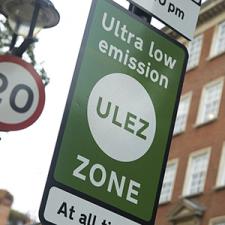
London’s Ultra Low Emissions Zone is set to be extended later this year. Alan Dowds reports on how it is affecting bikers in London and how similar schemes are being rolled out across the country.
For the nine million folk who live in Greater London, the letters ULEZ have become very familiar over the past few years. ULEZ stands for Ultra Low Emission Zone, and it was first planned by Boris Johnson when he was the Mayor of London in 2014. Under Johnson’s successor, Sadiq Khan, Transport for London (TfL) imposed the first stage of the ULEZ in 2019, covering the same area of Central London as the Congestion Charge. The ULEZ was expanded in 2021 to cover the area bounded by the North and South Circular roads, and TfL is set to expand it again, to cover all 32 London boroughs (and the City of London), covering the majority of the area inside the M25.
The ULEZ was planned to reduce air pollution, especially nitrous oxides (NOx), caused by petrol and diesel engines, and it imposed a charge on users of petrol cars and vans built before 2006, and diesel cars/vans from before 2016. It also affects pre-Euro 3 emissions-compliant motorcycles, which is most bikes older than 2007. To enter the ULEZ on a non-compliant vehicle, you have to pay a flat £12.50 daily charge.
Now, if you’re living outside London, you might be sitting with a smug look on your face. But variations on the ULEZ, called Clean Air Zones (CAZ) are already in operation in other UK cities, and more are on the way. There are four classes of CAZ, from A to D, with A the least stringent, covering buses, coaches and taxis, and D the tightest, covering all vehicles, including private cars and, if the local council decides to, motorcycles. None of the schemes outside London, including the Class D Zones in Bristol and Birmingham, cover motorcycles at the moment. But, of course, there’s no guarantee that will remain the case in future.

To get a view of the ULEZ system from the front line, I spoke to Neil Freeman of Riverside Motorcycles in Bow, East London. He’s been working to help owners of older bikes since the ULEZ zone first launched, modifying their bikes to meet the ULEZ emissions limits, and issuing test certificates. TfL accepts these certificates – as well as certificates of compliance from bike manufacturers – as proof that a bike is exempt from the charge.
“I’ve been a dyno operator for more than 25 years,” said Freeman, “and been doing ULEZ testing for close on four years now. There aren’t any bikes that we haven’t been able to make compliant.”
Freeman takes the example of a 1998 Yamaha Fazer 600, a common bike which isn’t ULEZ-compliant as standard but can be modified to clean up its NOx emissions. “An FZS600 can generally be ‘brought to heel’ with carburation setup. But the labour costs mean it’s a better option to just retrofit a three-metal catalytic converter to the exhaust system prior to the test, ensuring the bike will comply first time, at far lower a cost than modifying the carb setup.”
Freeman’s experience means he can quickly advise customers on how their bikes can be made ULEZ-compliant. “We have an extensive database of thousands of bikes and can advise where you could expect it to test. And with the aim of offering a compliant bike for the least cost to the consumer we can advise on what we would do if it was our decision. The goal here is to make the motorcycles compliant for the lowest cost.”
So – owners of old bikes can pay for a ULEZ test and modifications if needed and will avoid the £12.50 daily fee. Does that mean after the ULEZ expansion, Greater London will be full of older bikes then? Well, rather counter-intuitively, Freeman says no. The man who hands out exemption certificates reckons that most people are tending to replace their old bikes with newer, ULEZ-compliant models. And that the ULEZ has merely accelerated change that was happening anyway.
“Would I say that the ULEZ expansion isn’t having a big effect because there’s not that many old bikes in use in London? Yes, that’s exactly what I would say. It’s just the honest truth, I’ve got nothing to gain. People don’t really understand the attrition rate of bikes built between 1981 [bikes older than this have classic vehicle status and are exempt from the ULEZ] and 2006.”
Meanwhile, Freeman reckons that motorcycle use in London is suffering from some far more serious factors than the ULEZ. “I’m going to sound like I’m all doom and gloom, but the state of London’s motorcycle trade is extremely poor. We’re only staying in business because all the other places round here shut down 10 years ago. I’ve had two speeding tickets in the last two months in the 20mph zones. The traffic is a pain, as is finding somewhere to park. The biggest issue is not the ULEZ, as much as theft and parking.”
So, it seems that the ULEZ story in London is far more complex than it might initially appear – even before the expansion to outer London. It remains to be seen how low emissions zones across the UK will develop – whether they will continue to exempt motorcycles from charges, and if not, how less affluent areas of the country will manage with older bikes being priced off the road.
Clear Air Zones
There are currently Clean Air Zones in operation in Bath (Class C), Birmingham (Class D), Bradford (Class C), Bristol (Class D) and Portsmouth (Class B). CAZ are planned in Sheffield, Tyneside and Greater Manchester. More details on the gov.uk website: www.gov.uk/guidance/driving-in-a-clean-air-zone.