










There aren’t many firms which supply parts for both MotoGP racebikes and the most basic commuting scooters. But brake manufacturer Brembo does just that. As part of a massive outfit that also makes car and truck discs, pads and calipers, the firm’s motorcycle division encompasses an incredibly wide range of products in its AP Racing, Brembo, ByBre and SBS brands.
We spoke to the chief operating officer for Brembo’s motorcycle division, Sebastiano Rio, starting off with how the firm coped during the Covid pandemic and in its aftermath. “Unfortunately, I have to say that in the past three years, since I came to motorcycles, we have had everything: the pandemic, logistics problems, chip shortages, war. Now, I am really worried about the next problem, but I hope it will be positive! Joking aside, despite everything, talking about motorcycles, it is doing well. We have taken over SBS and our mission is to be a systems provider and a solutions provider.”
The reference to ‘solutions provider’ comes from a change announced in 2020 by Brembo, when it spoke about moving from merely supplying components to customers, and providing overall solutions instead, leveraging all its experience and knowledge.
He accepts that there have been plenty of hurdles for Brembo since 2020. “It has been a pretty tough period. The pandemic was creating panic at the beginning, and this came at the very high season of motorcycling. We were very pessimistic: you can imagine, losing the second quarter in motorbikes is a disaster, and Brembo had been closed for more than a month. But we were lucky because the market reacted, and despite what the forecasts said, we were pretty strong in the second half of the year. Off-road was really flying, especially in the US, because of people spending time in different ways because of the pandemic.”
The firm faced familiar problems with logistics and shipping to OE customers. “Due to logistics, due to container availability, due to the sea trade, and the availability of overall transport, everyone was suffering.”
And even when Brembo could get its brake parts and systems through to manufacturers, production would stop due to shortages of other parts. “Suddenly they were suffering [shortages] for plastic components and tyres. There was a lot of incomplete production. From our own side, we had some trouble, we never stopped due to availability. But then the big chip problem came and that was another disaster.”

Bikes need silicon chips for fuel injection of course – and ABS systems. Brembo doesn’t produce the ABS ‘brains’ itself – those come from the likes of Bosch and Continental. But if the ABS units aren’t available, Brembo can’t supply complete brake sub-assemblies to bike assembly lines. Having said that, firms were still keen to take what Brembo could give them, with bikes built as far along the production line as possible, then completed when the remaining parts arrived. And the variable nature of the shortages meant Brembo wasn’t hit as hard.
“I would say that the chip availability problem really hit Europe, the US, and India,” said Rio. “But none of them came at the same time. We were having slowdowns in different regions, but overall, there was no dramatic reduction in overall volume.”
Of course, once the logistics problems and chip shortages began to ease, war kicked off in Ukraine at the end of February 2022. Rio reckons the impact was short-lived though, especially with the booming market for Brembo clients like Ducati (which sold a record number of bikes in 2022). “Now there is a war but actually today we are okay apart from the very beginning when we were having some trouble getting specific materials, mainly for pads, or even aluminium. Even then we were having a pretty busy period.”
In January 2021, right in the middle of the Covid pandemic, Brembo bought Danish brake firm SBS for €30m. Now that the world is getting back to normal, what is the role of that brand for Brembo? Rio tells us that it will be a big part of the firm’s aftermarket performance/upgrade strategy. “SBS has its own brand identity, which is very strong in the market, and we want to reinforce it. In the aftermarket, SBS is very well recognised, so no changes at all in the overall strategy.”
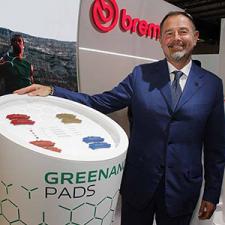
Brembo made another big announcement at the end of 2022, with the release of its new Greenance brake pads. These have been designed to minimise environmental impact, during both production and use. The new production process uses less energy, and with no copper, nickel, antimony or asbestos in the pads, the particulate matter created during braking is cleaner.
There are no statutory environmental rules for brake pads – yet. But Brembo reckons it’s ahead of the game with its new pads, which perform better than older designs. “‘Greenance’ is a marriage between ‘performance’ and ‘green’,” said Rio. “It’s a sustainable product without any compromises on performance. We improved our compound, we removed copper. In terms of friction coefficient, it’s roughly 10% better. The new process is absolutely sustainable and green, using 65-70% less energy in production.
“We took a decision to enter our sustainability strategy last year and a year later we’re presenting a product, despite no one asking for it! There is no legislation, nothing that is obliging us, but we want to make it perform and for sure we are the first absolutely in this field.”
And the Greenance range will eventually cover almost all Brembo’s aftermarket brake pads, except the very highest performing race and track parts. “The green pad is going to cover almost 95% of the entire range from scooters up to high-end motorcycles.”