









Discounting the pre-election gibberish that we’ll have to endure until Rishi Sunak surrenders to the inevitable, UK prospects are not in a happy place. Neither is the motorcycle industry. BDN financial editor Roger Willis surveys the situation.
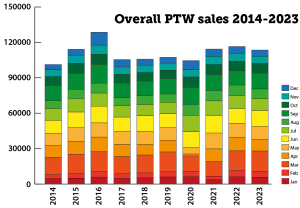
A difficult past 12 months has seen UK powered twowheeler registrations fall by 2.5% year-on-year to 113,589 units. Pertinently, that is also 0.7% lower than the immediate
post-Covid resurgence burst in 2021, which saw numbers climb by 9.3% to 114,371. Stagnation is one appropriate word. The cost of living crisis hasn’t gone away, growth in the UK economy is nonexistent and global geopolitical pressures are mounting.
Conflict zones from Ukraine to the Middle East are currently beyond control. The supplychain mayhem that characterised Covid’s impact is already returning with a vengeance. Attacks on shipping in the Red Sea by Iranbacked and missile-equipped Houthi militias are debilitating European access to Far Eastern goods once again. Traffic through
the Suez Canal has so far dropped by 90%.
According to the Shanghai Containerised Freight Index, the cost of moving a 40ft container
on a series of long-haul routes has reached its highest level since the pandemic. The price
from Shanghai to Rotterdam rose from $1667 on 23 December to $3577 by 5 January. Shanghai to Genoa went up from $1956 to $4178. They’ll keep on rising, as will inflating prices for the goods therein. The boss of shipping giant AP Moller-Maersk told journalists on 10 January that it could take months to reopen the crucial Red Sea route, risking a major hit to the global economy.
Triumph Motorcycles, in its latest results statement, anticipated such scenarios. “The principal risk we face is a potential, and indeed expected, downturn in the global economic climate,” the company opined. Sadly, the UK bike industry’s voice remains complacent.
Commenting on annual registrations in early January, MCIA chief executive Tony Campbell hailed a rosy future: “2024 will be an exciting year for the sector which will be built upon another solid performance in 2023. The scooter, motorcycle and now light three and fourwheel market will become an even more important contributor to the transport ecosystem.” Is he on the same planet? Perhaps not.
Winners and losers
Nothing illustrates market stagnation during the past year better than Honda’s performance. Maintenance of its leadership was achieved by selling an unlucky 13 fewer bikes than in 2022. For most brands demonstrating degrees of success, measured recovery
from long-term supply chain issues, parts shortages and disrupted production in the Covid pandemic’s wake was responsible. Yamaha, KTM and Kawasaki certainly fitted this category.
Besides sorting out its supply chain destined for European dealers, Yamaha also prospered from ongoing dominant fleet delivery scooter input in the UK. Kawasaki bounced back after shambolic 2022 Japanese production, that had left KME struggling to meet Europewide dealer inventory demand. In the UK, it dropped out of the MCIA chart altogether in February 2022 and only shifted a notably reduced total of 4822 bikes in that year’s remaining chart-recognised 11 months. A much healthier fully-clocked tally in 2023
was more than 20% up.
British BMW Motorrad dealers probably had the best year, with sound growth of premium-priced products, but narrowly failed to meet a Teutonic management target of 10,000 annual UK sales for the first time ever in 2023, despite Q4 assistance from early arrival of the heavily-hyped new R1300 GS model.
Triumph wasn’t that far behind on just 546 fewer bikes and modestly positive – although the reality checks on cost-consciousness in its annual financial results appearing elsewhere in this issue should be noted.
Among the also-rans with inconvenient gaps in their MCIA chart data, Chinese flag carrier Lexmoto suffered the most severe pain. A full 12 months of figures in 2022 had reached 5347 units, but that had already been 9.3% in arrears. Then an absence of sufficient stock in March 2023’s new-plate booster signalled consistently shrivelling numbers in the 11 months that were counted last year. These amounted to 3168, pointing to an approximate 40% sales decline. An inability to source fresh stock from China, where many motorcycle
manufacturers are afflicted by that country’s industrial woes, took the blame.
Royal Enfield blotted its UK copybook for a different reason, principally dispensing with MotoGB’s highly experienced distribution services, to take dealer network management in-house. 2022 had been a remarkable year for the brand, growing by 28.1% to 5246 units sold. However, MCIA top-ten chart data began to indicate progressively weakening numbers in 2023, until its presence disappeared in December. The 11 months to date prior to such ignominy totalled 4577 units and broadly suggested an annual shortfall of more than 10%. On veteran Royal Enfield dealer (who had better remain anonymous) told BDN that trading with the new distributive regime had become a “nightmare”.
On a brighter note, Suzuki pulled it corporate socks up splendidly in 2023, after several years of unremitting decline, thanks to a batch of well-conceived new models at very competitive price points. 2022 had been pretty dire. MCIA top-ten data was extremely thin on the ground, with no-shows in January, February, August and October. A reasonable guesstimate suggested barely 3000 bikes plated. Ignoring a solitary noshow in February 2023, 11 months of figures last year added up to a useful 4960 units. Staff on Suzuki’s Motorcycle Live stand were therefore bubbling with upbeat enthusiasm. There’s no shame in status as a budget brand in the current febrile climate.