








Last month, we spoke to Honda UK’s head of motorcycling, Neil Fletcher, about his background and how he sees his role. In the second part of our interview, we ask about his plans for the future – and how that affects its dealer network in the UK. Alan Dowds reports
Most senior management jobs are focused on the future. If you’re the head of a big operation, in whatever sector, it’s vital that you’re thinking not just about what’s happening now but what’s coming around the corner in a year, two years, or even longer.
That’s certainly true in the bike world, where we have an industry facing a couple of major uncertainties in the medium and long term. The demographics of UK motorcycling are well-known: we’re a bunch of older men generally, with all that brings, for good and ill. And with an upcoming agenda that includes decarbonisation, self-driving vehicles, road safety drives and increased regulation on things like speeding, biking has enough troubles and does not need to seek out more.
So, it was this future-gazing aspect of the job that we started with when we discussed Honda UK’s dealer network plans with its head of motorcycling, Neil Fletcher. “My first impressions coming into the job? Well, I was quite worried, if I’m honest, about both the age profile of the people who owned the businesses that were selling our bikes and the age profile of some of the customers. To be honest, I thought, where is this going to go in five years’ time?”
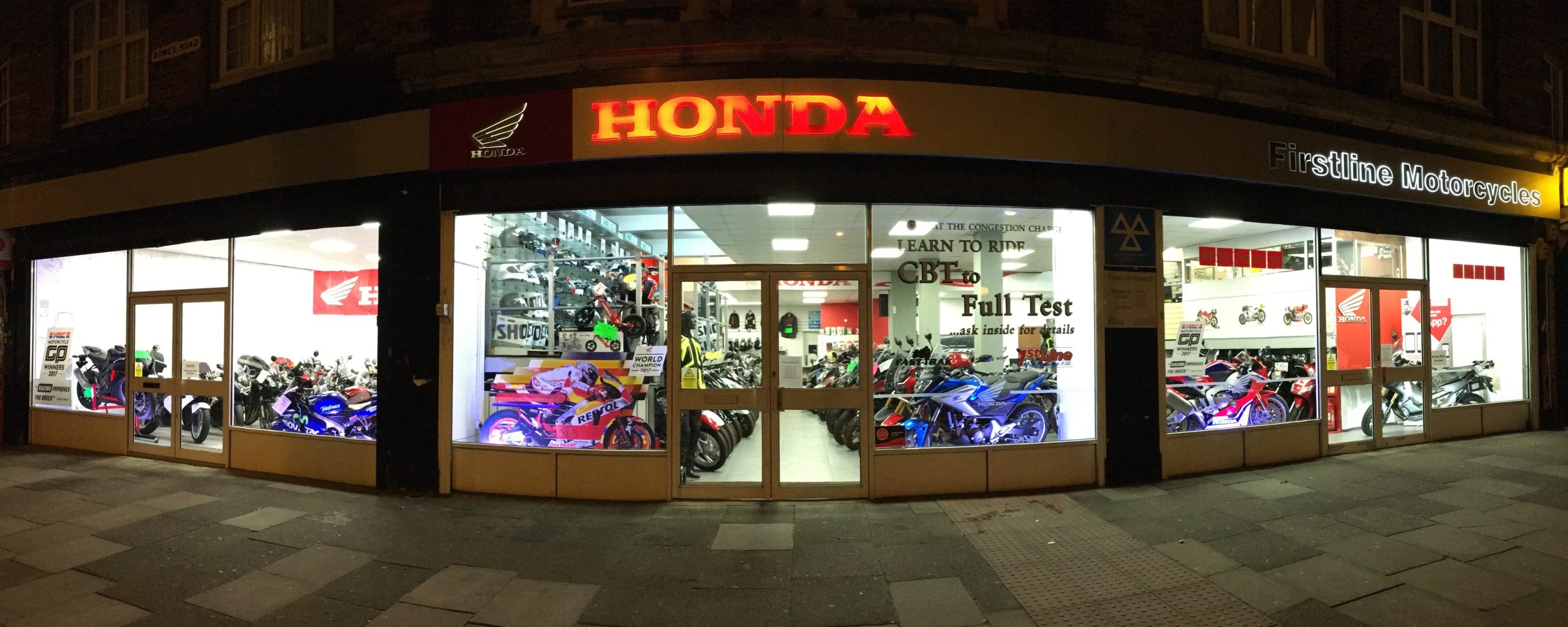 Grafton Motorcycles, Miles Kingsport and Firstline Motorcycles (above) all celebrated 45 years with Honda this year
Dealing with the age profile of bikers is an industry-wide issue, of course, and something that has no easy answer. But when it came to the dealer network, Fletcher could act. “We had probably something like 90 dealers, and I looked and thought, well X% of these guys are not going to be here [with Honda] in five years, though I’d hope they are still enjoying life and everything else! And I needed to understand what the picture looked like. It was interesting: I talked to some business owners, and they wouldn’t have thought about [their future]. They were busy running a seasonal business, which is their passion.
“At the same time, Honda has plans and ambitions for growth. You’ve seen that in the last two or three years with the growing model line. So I could see the retail network that we had was very competent but not necessarily going to be there in the long run. And some probably weren’t going to be big enough businesses to put in the investment needed.”
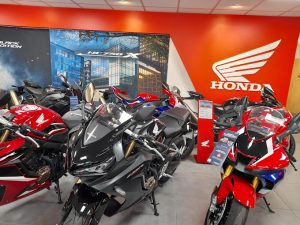 Grafton Motorcycles
Fletcher also saw a problem in terms of profitability. “We weren’t making enough money in the motorcycle business, either as the dealer network or as Honda UK. And it was clear that we were going to have to refresh a lot of the retail sites. So we set out on a mission to go and change that, and, very simply, the mission is to have fewer dealers. That’s the trend, and it’s going that way. But also to make sure that you have dealerships with a succession plan, suitable premises and everything else and then give them a bigger area of responsibility, which means they can get a bigger return.”
Fewer dealers, each making more money, from having a larger catchment area then? “It’s as simple as that. It is quite scientific inasmuch as you’ve got to work out the numbers. We’ve got a very clever bit of software for ride and drive times, and we’re generally in the very high 90% [of population within a reasonable travel time].”
What is the ideal size for this new Honda dealer network, then? “We’ve currently got approximately 60 outlets, and that’s not far off where I think we should be in terms of numbers. I think we have four key [geographical] areas where we haven’t got the right representation, or none, at the moment. So you could say it might go from 60 to 64. Or it may go to 58 before it goes to 62 or something like that, but it’s in that area.”
Where is Honda currently looking to place new retailers? “The big area is in the south coast – we’ve got Bournemouth covered, and we’ve got Pevensey Bay all the way over there, and then we have Crawley (P&H) and Doble in Coulsdon, and then Kent we’ve got covered. So it’s sort of Hampshire, Portsmouth, Southampton and towards Brighton, that coastal strip.
“That’s probably the biggest one. We’ve had a bit of a change around there, and we’re not rushing it because it is really a prime spot. We’ve effectively got two continuous territories, and we’re still pondering whether we should have one or two operators in that space because you could do it with one, but is that enough? And it would help if you were in the right place. It’s no good having one on the edge of the territory, so that’s an interesting one. We’ve had lots of different options on that, but we’re just biding our time.
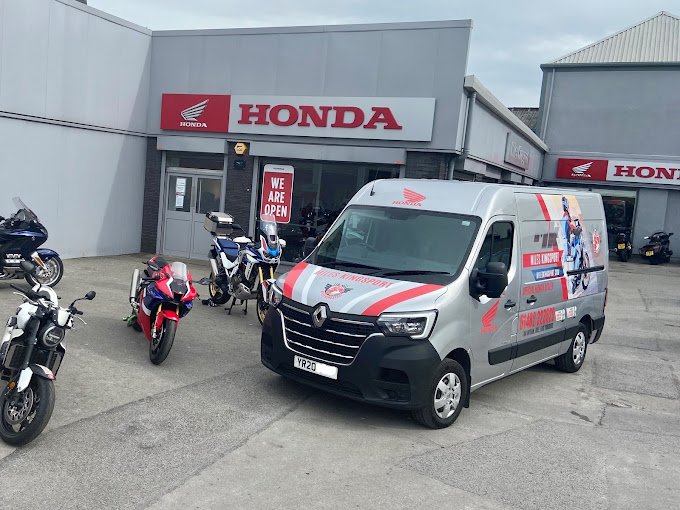 Miles Kingsport
“We’ve just got a new dealership in Aberdeen, Shirlaws, and I’m really pleased with that. That is an excellent example for me: it’s a new investor coming into the industry, taking over a very well-established and successful family business. There’s a Shirlaw still in the business. And that’s what we’ve been trying to do. We’ve been trying to attract either new or existing investment to do these things.
“One area where we don’t have any representation is South Yorkshire. We’ve got operators around it, but we don’t necessarily have one in the right place. And there are probably two other areas.”
The other side of the network development coin – often ending long-term business relationships – is more brutal, of course. And Fletcher is keen to stress how much effort he and his team put in there. “There are three businesses at the moment that we’re trying to help with a dignified exit. I want to be able to look myself in the mirror and say, have we given each of our existing dealers a clear direction? Do they know our expectations, and have we been fair and equitable? Now, I’m sure some of them would argue that we haven’t. But we’ve always tried to do that, and while I am in this role, I’ll always try to do that.”
Is it fair to say that some of this change would be inevitable anyway? Is Honda’s strategy simply speeding up the inevitable evolution of an industry which has had too many retailers in the past? It seems likely. “If you go back before my time, there were hundreds of dealers. There was a Honda dealer in lots of market towns, and that just isn’t viable in today’s world,” said Fletcher. “But I think there are dealers who we’ve helped move to whatever they want to do next, and they would say if we hadn’t had the discussion, they wouldn’t have done it. We’ve tried making it as palatable and reasonable as possible.”
And Fletcher insists that he and Honda have both been transparent throughout. “Before we did anything, in 2018, we said, ‘This is what we’re going to do; the long-term future of the network is to have fewer dealers to sell more bikes’. We started that whole conversation, and basically, we were saying don’t be afraid to come to us and say, ‘I’m thinking of selling the business’, or ‘I need to retire’ or whatever.
“And I think there was a reticence, a concern that we would turn around and say, ‘Right, well off you go then’. But that doesn’t do us any favours because we’ve got customers who want continuity and all that sort of thing. So we tried to literally work out what the strengths and the weaknesses were in each case. That might be, is there a succession plan? Is the family or the management team happy to take it on after the incumbent dealer principal or owner? Is there enough funding in the business?”
Not long after this process had begun, though, the tsunami of Covid-19 hit, and all bets were off. However, the effects of the pandemic were more complex to interpret at first, as Fletcher relates. “Firstly, the industry did very well in Covid, and it put a lot of money back in the coffers of some businesses that hadn’t been doing so well, which was good. It put them on a more solid footing to make better decisions. But it also then drove people to think about the future. I mean, I think we all did. What am I doing waking up at 6 o’clock in the morning to do all this stuff? And some of those conversations we were having became a bit more real and a bit more poignant.”
Who manages the network change processes? “I personally have to sign off all the decisions, so in the end, it’s me. It’s me, together with Richard Schofield, who runs the sales side of the business, Andy Mineyko and Craig Horne, our franchise development managers. And we also involve the area team because they’ve got much deeper knowledge than me.”
And what percentage of Fletcher’s time does this take up? “Increasingly, it’s become quite a big thing for me. I think there isn’t anything much more important that I could be doing with my time, apart from my team and putting effort into them. A lot of it is discussion; what are you thinking? I mean, I’ve got one conversation going on at the moment, which I feel quite awkward about because I’m pushing hard for that person to think about what they’re going to do with their future. It’s their money, it’s their business, I respect that massively. But I know that they need to make a decision, for them as much as for Honda.
And so I’m investing a lot of time and effort trying to make that happen. Honestly, am I pushing it too far? Am I not pushing enough? That’s the bit I have to keep asking myself.”
It’s clear that the man from Honda is deeply involved in this process and takes it very seriously on a number of levels. “What I want to get across is this: none of these have been knee-jerk decisions. Some of the discussions are more amicable than others, let’s put it that way and some of the very clear signals that we put out there are ignored, and that can only go on so long because, in the end, I’ve got to do what’s right for Honda. But it’s a tricky one. I like to think that my team at Honda are people-orientated: it’s a people business and a small industry, and we’re trying to do the right thing.
“I’m also very conscious that we are the market leader, and if we do the wrong thing, I think that can send all sorts of signals out there, and that’s not good because the big thing I’m very keen to do is get in new investment. I think what we’ve demonstrated to the dealer network, and I think they’re seeing that, is that Honda cares, for want of a better word.”
When all is said and done, though, Honda will still have – and wants – a fair degree of continuity in the network. “The vast majority of the dealers we’ve got are dealers that we have had for years,” says Fletcher. “Take Mark Smith up in Chester, for example. They’ve consolidated into Honda and built a new showroom with a new corporate identity, and that’s them nailing their colours to the mask for the next 10, 15, 20 years, whatever it is. And that’s great, and that’s what I want. Ideally, we want the people that we’ve already got to be able to be the people that are still here in 20 years’ time. We’ve actually put together a significant multi-million-pound investment fund of our own, which the dealers get towards the development of new facilities. We’ve proven the profitability is there if you do it, and we are also putting our money in to help out. It won’t cover all of it, but we believe in it, and I think that’s important.
“So look, I’m not trying to put a picture of us being perfect. But we have had really strong profitability nationally; the strategy we’ve followed has borne fruit in the sense that those 60 dealers, if you look at the growth of their profitability over the last five years, it’s grown and grown and grown.”
A future, surely, that every senior manager in the bike world would want to see…